Know what a price move will do — before a customer sees it.
Patent pending. U.S. provisional filed November 2026.
We find the price moves worth making, validate each one on brand-calibrated simulated shoppers, and project its business impact. The brand stays in control: one click to ship, one click to roll back. Then we measure what actually happened — misses included.Evidence before exposure.
1 / 15
Problem
Pricing has extraordinary leverage. Demand response is the unknown.
A 1% price increase can move operating profit ~9%1 — but commerce pricing is still run reactively.
01
Bestsellers remain untouched
Margin leaks because teams are afraid to touch winners.
02
Discounting destroys avoidable margin
Brands cut price to move stock, even when it destroys gross profit.
03
Decisions are delayed or made by instinct
Teams suspect a move is right, but lack the evidence to ship it.
Current tools answer adjacent questions. Parbat closes the decision gap.
Analytics
What happened?
Repricers
What does the market charge, and what rule should run?
Intelligems
Which selected price wins on live traffic?
Parbat
Which moves deserve action, what are they likely worth, and do they clear our constraints before exposure?
Parbat is the pre-exposure decision layer. Live A/B tools still have a place when confirmation is worth the traffic and time; Parbat answers the question before any traffic is spent.
3 / 15
How it works
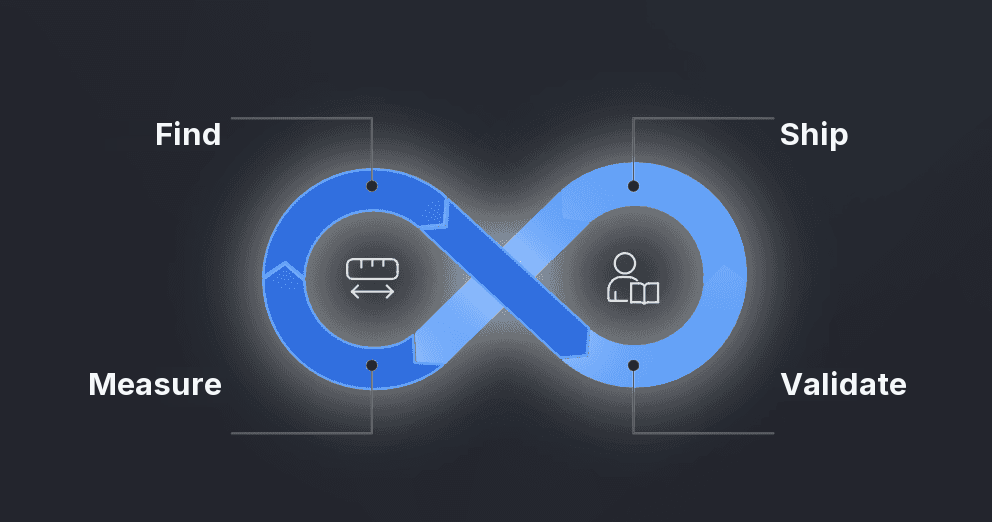
Parbat turns pricing into an Evidence-Before-Exposure system.
Find
Every morning, rank the price moves most likely to add incremental gross profit, from the brand’s own traffic, conversion, margin, inventory and price history.
Validate
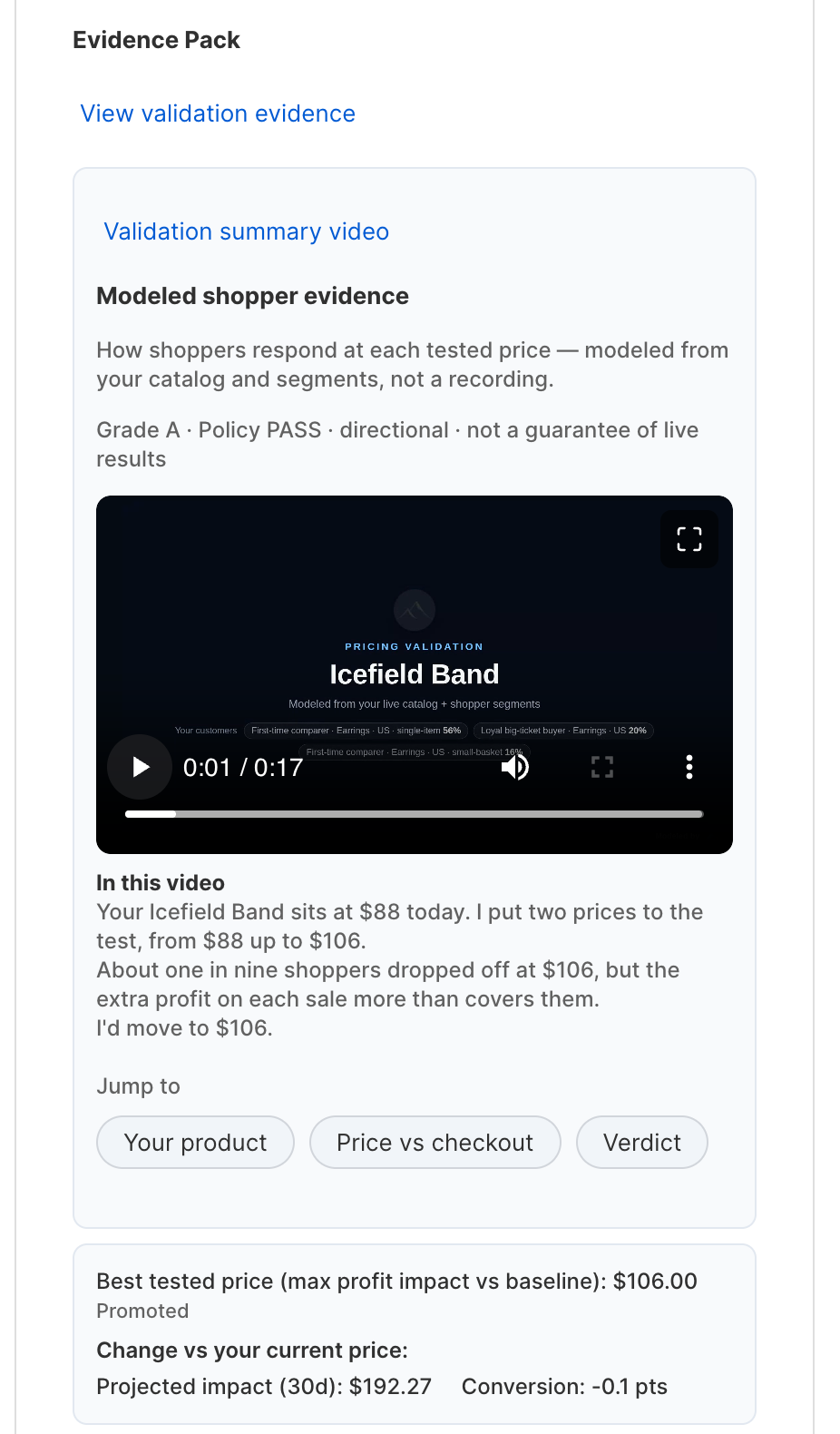
Test each candidate on brand-calibrated simulated shoppers at every price, and check its margin floor, MAP and exclusions before it can ship, and again on every variant when it does.
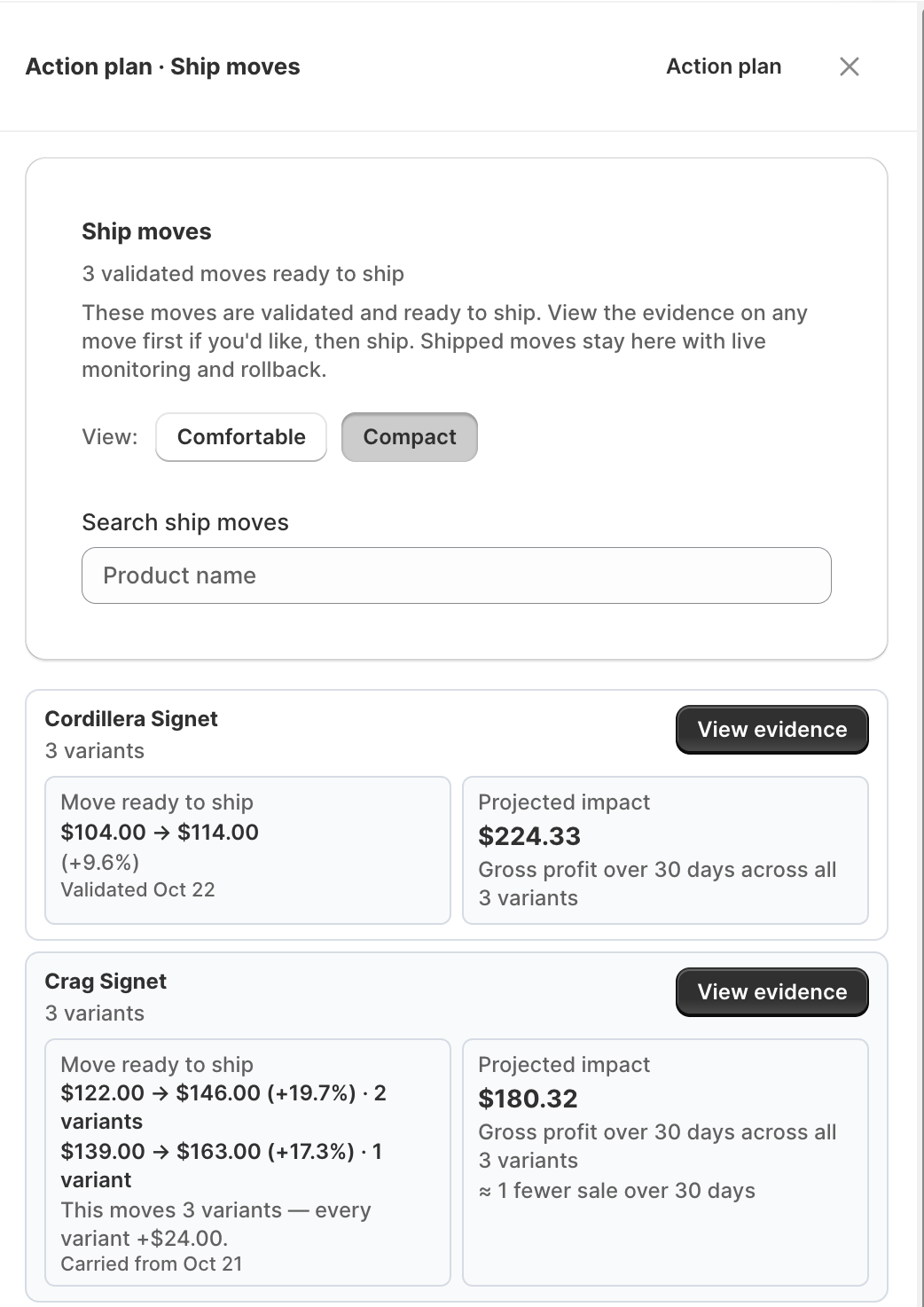
Ship
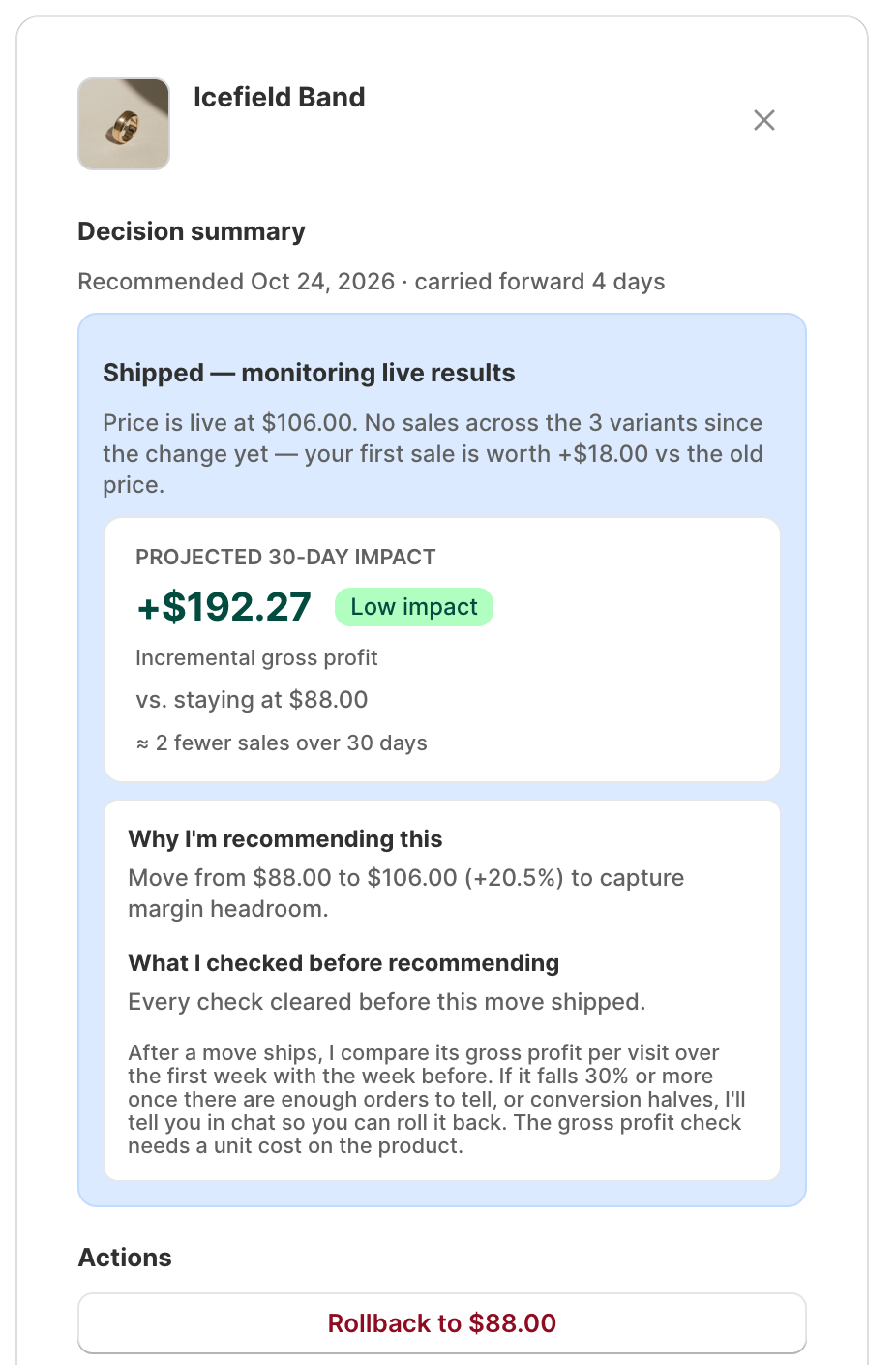
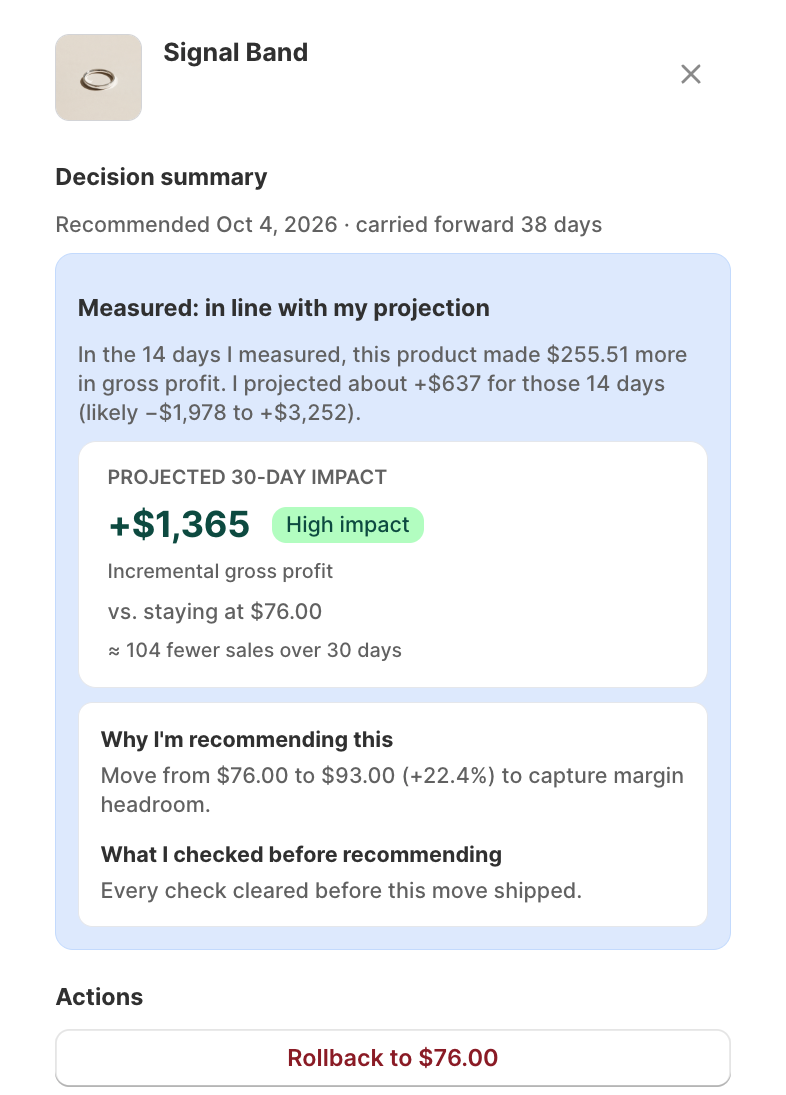
Only the brand ships. One click puts the price live and one click rolls it back. Every shipped move carries its Evidence Pack.
Measure
Measure each shipped move’s realized gross profit against its projection, misses included. Built to feed those outcomes back into finding and validation once a brand has 20+ scored moves per direction.
Models propose. Validation generates evidence. The brand ships. Measurement recalibrates.
First measured outcomes from our design partner, with confidence ranges: Q1 2027
6 / 15
Why now
AI made recommendations cheap. Trustworthy execution is still scarce.
Shopify provides a standardized data and execution surface
Modern demand modeling makes catalog-wide screening feasible
Governance, calibration, and accountability are now the bottlenecks
The missing layer is not another recommendation engine. It is a controlled system that validates and governs changes before exposure.
Pre-exposure pricing decisioning is feasible now in a way it wasn’t a few years ago.
7 / 15
Ideal customer profile
Start where a price change matters, and its result can be measured.
Pricing matters
$500K–$20M in annual Shopify sales
25%+ gross margin on target products (40%+ is ideal)
Founder, GM, or head of ecommerce decides price changes — including markdowns
Results can be measured
15+ products each doing 20+ orders a month
Real price-change history across the catalog
80%+ of revenue through their own storefront
We land with one narrow promise: help ship a small number of profitable, safe price changes quickly.
8 / 15
Market size
~$360M combined ARR across Shopify (U.S. and global) and other storefronts, inside a $1.4B TAM.
~7,000 brands
U.S. Shopify DTC brands that fit*
× $6K–$12K ACV
Two plans; the SAM assumes Growth for $1M+ brands, Starter below
= $78M ARR
Serviceable addressable market
Expansion paths
Global Shopify: ~10,000 brands, $120M ARR
Other storefronts: ~20,000 brands, ~$240M ARR
Multi-store and multi-brand price controls
Broader measurable commerce decisions
Top-down TAM: $1.4B a year, every $1M+ online store worldwide at $12K, once we reach other storefront platforms. Assumed, not measured: Shopify’s 25–40% share of those stores, and the ACV.
* Bottom-up estimate, carried as a range. Method and sources in the diligence appendix.
9 / 15
Business model
B2B SaaS: a few modest pricing wins a month can cover the subscription.
Initial pricing
Two annual plans
Growth $12K and Starter $6K a year. Both validate every move before it ships; Growth adds open-ended what-if scenarios, launch pricing and, after the beta, auto-shipping within the brand’s limits; Starter caps the products under management.
Expansion
Global Shopify and other storefronts, multi-store and multi-brand price controls, and broader measurable commerce decisions
Customer break-even
$1,000
per month incremental gross profit to break even on Growth; $500 on Starter
Founding beta brands get their first year free. No performance fee in the initial model.
10 / 15
Go-to-market
Land beta brands → prove lift → scale through Shopify-native distribution.
Founder-led selling fills the first eight brands. After the beta, the Shopify App Store becomes the main way in, so growth does not hang on a large sales team.
Land
Founder-led outreach fills the 8 founding-beta seats: design-partner referrals, heads of eCommerce, and brands in the beachhead segment.
Prove
Measure every beta move against its projection, misses included, and publish 3 case studies with measured profit impact.
Scale
After the beta, the App Store listing (direct link only today) goes fully visible. Repeatable onboarding, agencies and case studies will bring brands to it.
Key GTM metrics: Install to first Evidence Pack, Beta-to-paid conversion, Time to first shipped move, Onboarding cost, Gross retention and expansion
11 / 15
Moat
The compounding asset is brand-specific calibration.
Every shipped move creates a proprietary intervention record:
Decision context
Candidate price
Projected outcome
Uncertainty
Policy state
Brand decision
Realized outcome
What improves
Parbat scores every shipped move’s projection against its outcome, by brand, and adds bias and interval coverage as scored moves accumulate. As the system observes more interventions, brand-specific calibration should improve and uncertainty should narrow only where the evidence supports it.
Why switching has a cost
A new provider can access historical orders. It does not inherit Parbat's exact projection, policy, ship, rollback, and outcome lineage—or the calibrated model state produced by those interventions.
The moat exists only if calibration error improves with use. We measure that directly.
12 / 15
Vision
Shopify pricing is where we start. The same loop extends to more decisions and more channels.
Parbat starts with Shopify pricing because pricing is frequent, high-leverage, measurable, and under-operationalized.
But the core system is not limited to price changes, or to Shopify.
More channels ↑Other storefrontsPricing on ShopifyInventoryMerchandisingShippingMore decisions →
Validate Economic Impact
Predict the outcome of proposed commercial actions before they go live.
Enforce Safety & Governance
Ensure changes align with business guardrails and policies.
Ship Optimized Decisions
Launch only what is economically attractive and validated.
Learn from Outcomes
Continuously refine models based on realized results.
We're building simulation-led decision infrastructure for commerce — starting with pricing, and expanding only where the economics can be measured.
13 / 15
Team
Three years inside the workflow. Product live in 2026.
Parbat did not start as a generic AI pricing idea. We spent the last three years embedded with a live design partner, observing how pricing decisions were actually made in practice: too much manual judgment, too little evidence, and no safe path to ship.
That led to the belief that brands do not need more pricing analytics. They need a system that helps them find, validate, and ship pricing decisions with confidence.
Farrukh Zaman
Founder and CTO (full-time)
Built production platforms at Cisco and Salesforce. Changing prices on a live store is a systems-trust problem before it’s a modeling problem, and that’s the work he's done for years. He took Parbat from zero to a Shopify-approved app with a live design partner.
Zahara Malik
Co-Founder (advisory → full-time post-raise)
VP, Qualitative Research at Ipsos. Before that, twelve years at Dynata, rising from an intern to VP, Platform Solutions, where she led sales of its market-research and data products and launched a SaaS product with Fortune 500 clients. She joins full-time after the raise and will own sales.
This is not a market thesis that we formed from the outside. It's a decision process which was learned first-hand and built into software.
14 / 15
Ask
Raising $500K SAFE to turn one live loop into repeatable, paid proof.
Milestones
Run the 8-brand beta to measured results
Publish 3 case studies with measured profit impact
Sign 10–15 brands to annual plans: $120K–$180K contracted ARR on Growth
Make onboarding and calibration repeatable, so new brands go live without hand-holding
The next financing milestone: measured, repeatable pricing outcomes across brands.